
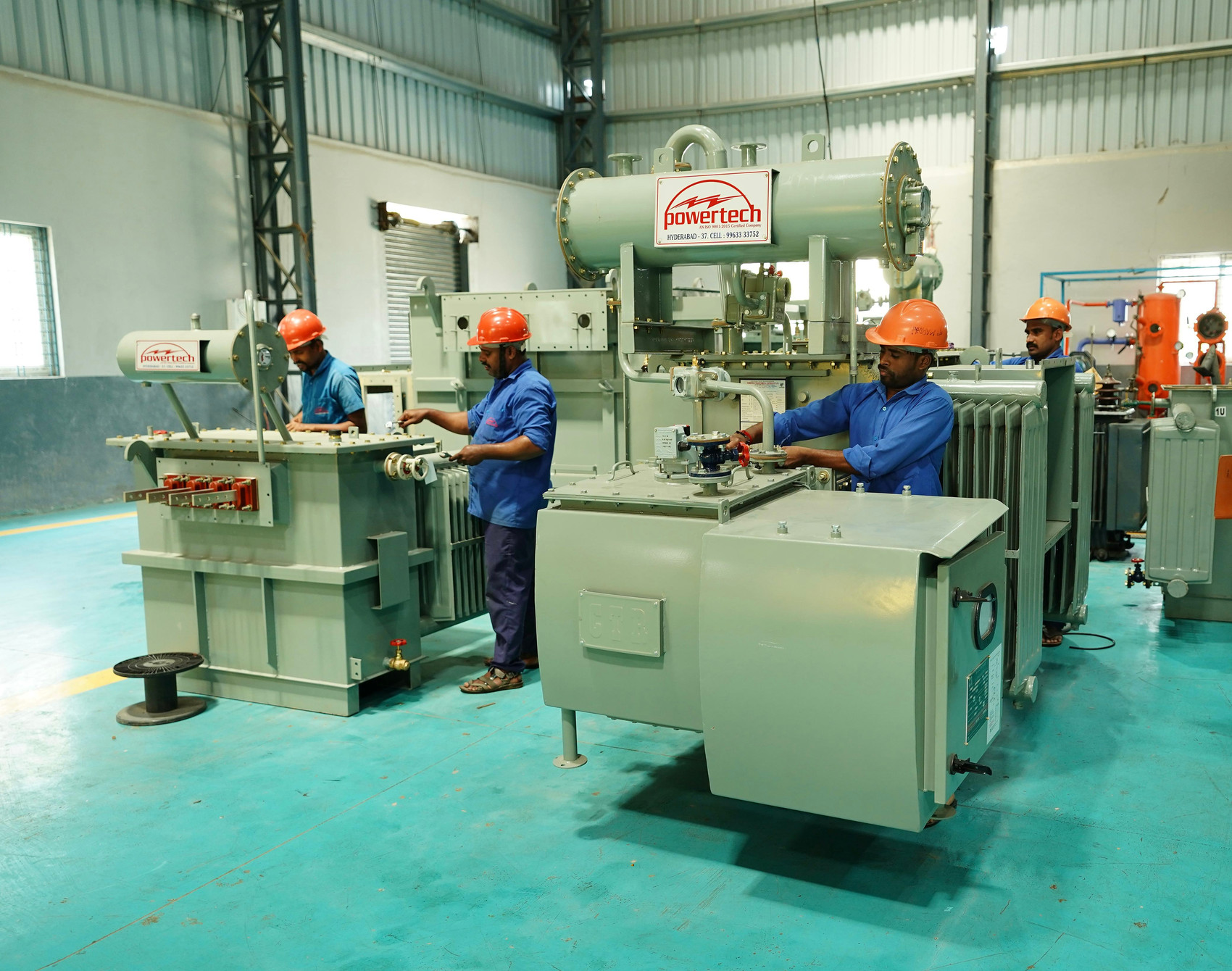
Almost every project we quote starts with the same question: oil cooled or dry type? The honest answer is that neither is better — they fail in different ways, cost different amounts and suit different buildings. Here is how we work through it with a client.
1. Where will the transformer physically sit?
This decides more than anything else. An oil cooled transformer contains mineral oil, which is a fire load. Indian electrical safety practice and most insurers want oil filled units outdoors, in a dedicated masonry enclosure, or in a fire-rated room with an oil soak pit and adequate separation.
If the transformer has to live inside an occupied building — a basement below a hospital ward, a plant room on the fourteenth floor of an office tower, a data hall — a dry type transformer is usually the only sensible answer. Cast resin windings are self-extinguishing and carry no oil, so there is nothing to leak and nothing to feed a fire.
2. What is the rating?
Dry type transformers are commercially sensible up to around 2.5 MVA and 33 kV. Above that, oil cooled construction wins decisively on cost per kVA and on thermal performance, because oil is a far better coolant than air. We build oil cooled units to 16 MVA; a dry type at that rating would be enormous and eye-wateringly expensive.
Below 2.5 MVA the choice is genuinely open. Above it, physics and economics both point to oil.
3. What does the site do to the transformer?
Dust, salt, humidity and chemical vapour all matter. A sealed oil filled tank shrugs off a coastal or dusty environment better than an air-cooled winding, which needs a clean airflow to reach its rating. Conversely, in a clean indoor plant room a dry type unit will run for decades with almost no attention.
- Coastal Andhra Pradesh, cement plants, mines — favour oil cooled in a proper enclosure.
- Hospitals, malls, IT parks, basements — favour dry type.
- Solar and wind sites — usually oil cooled, often inverter duty, sited outdoors on a plinth.
4. Who maintains it, and how often?
Oil cooled transformers need a maintenance regime: oil BDV testing, breather silica gel changes, gasket checks, Buchholz relay inspection. None of it is difficult, but it has to happen. If the client has no electrical maintenance team and no AMC, that regime will quietly lapse.
A dry type transformer needs periodic cleaning of the windings and ducts, and little else. For a building owner with no in-house electrical staff, that difference is worth real money over twenty years.
5. What do the losses cost over the asset life?
Do not compare capital cost alone. A transformer runs for 25 years or more, and no-load losses are paid for every hour of every one of those years. On a 1000 kVA unit, a 200 W difference in no-load loss is roughly 1,750 kWh a year — real money at industrial tariffs.
Ask any manufacturer for guaranteed no-load and load loss figures, and make them contractual. We publish ours on the test certificate for every unit we despatch.
A short decision table
| If this is true… | Then specify |
|---|---|
| Indoor, occupied building, fire risk matters | Dry type (cast resin) |
| Rating above 2.5 MVA | Oil cooled |
| Outdoor plinth, dusty or coastal site | Oil cooled |
| No maintenance team on site | Dry type |
| Solar or VFD load with high harmonics | Inverter duty, usually oil cooled |
| Tight plant room, needs HT + LT in one unit | Compact substation with a dry type core |
Where Powertech fits
We build both, in the same works in Balanagar, Hyderabad, which means the recommendation you get from us is not steered by what we happen to make. Oil cooled to 16 MVA and 33 kV under BIS licence CM/L-6300036494; cast resin dry type from 100 kVA to 2.5 MVA. Send us the single line diagram and the room dimensions and we will tell you honestly which one your project wants.