
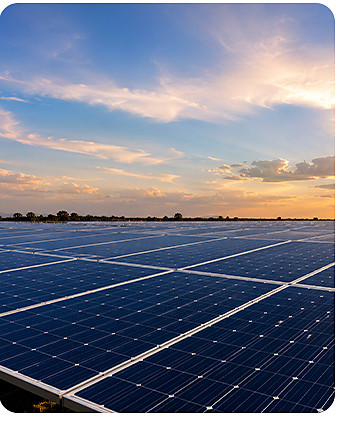
Telangana and Andhra Pradesh have some of India's best solar irradiance and a great deal of installed capacity to show for it. They also have a quiet population of transformers that failed years before they should have, because a standard distribution transformer was specified for an inverter-fed duty.
What is different about an inverter load
A solar inverter does not produce a clean sinusoid. It produces a switched approximation with significant harmonic content. Harmonic currents cause additional eddy current losses in the windings and stray losses in the tank and clamping structure — losses that scale roughly with the square of harmonic order.
The practical result is that a transformer carrying its nameplate kVA of harmonic-rich current runs hotter than the same transformer carrying clean current. Run insulation hotter than its class allows and its life halves for roughly every 6–8 °C of overtemperature.
What an inverter duty design does about it
- Lower flux density in the core, so there is thermal headroom for harmonic losses.
- Transposed or foil windings that reduce eddy losses at harmonic frequencies.
- Increased cooling surface — more radiator area for the same nameplate rating.
- Electrostatic shielding between windings where common-mode noise matters.
- Insulation and clamping designed for the duty cycle, not a steady-state load.
The daily cycle nobody specifies for
A solar transformer is energised at dawn, ramps to full load by midday, falls away by evening and sits unloaded overnight — every single day for twenty-five years. That is roughly 9,000 thermal cycles. Gasket sets, clamping and paint systems all need to be chosen with that in mind, which is not the same brief as a factory transformer running flat out on a constant load.
Nine thousand thermal cycles is the specification that separates a solar transformer from a distribution transformer.
What to put on the enquiry
| Parameter | What to state |
|---|---|
| Rating | Up to 17.6 MVA |
| Voltage class | Up to 33 kV |
| Cooling | ONAN or KNAN |
| LV inputs | 1, 2, 3 or 4 windings to match inverter blocks |
| Vector group | As required by the grid connection |
| Harmonic spectrum | The actual inverter THD, not a generic figure |
| Standard | IS 2026 / IEC 60076 |
| Ambient | Site maximum, not 40 °C by default |
One thing worth insisting on
Give the manufacturer the inverter datasheet, not just the kVA. The harmonic spectrum drives the design. A manufacturer who does not ask for it is quoting you a standard transformer with an inverter duty label on the nameplate.