
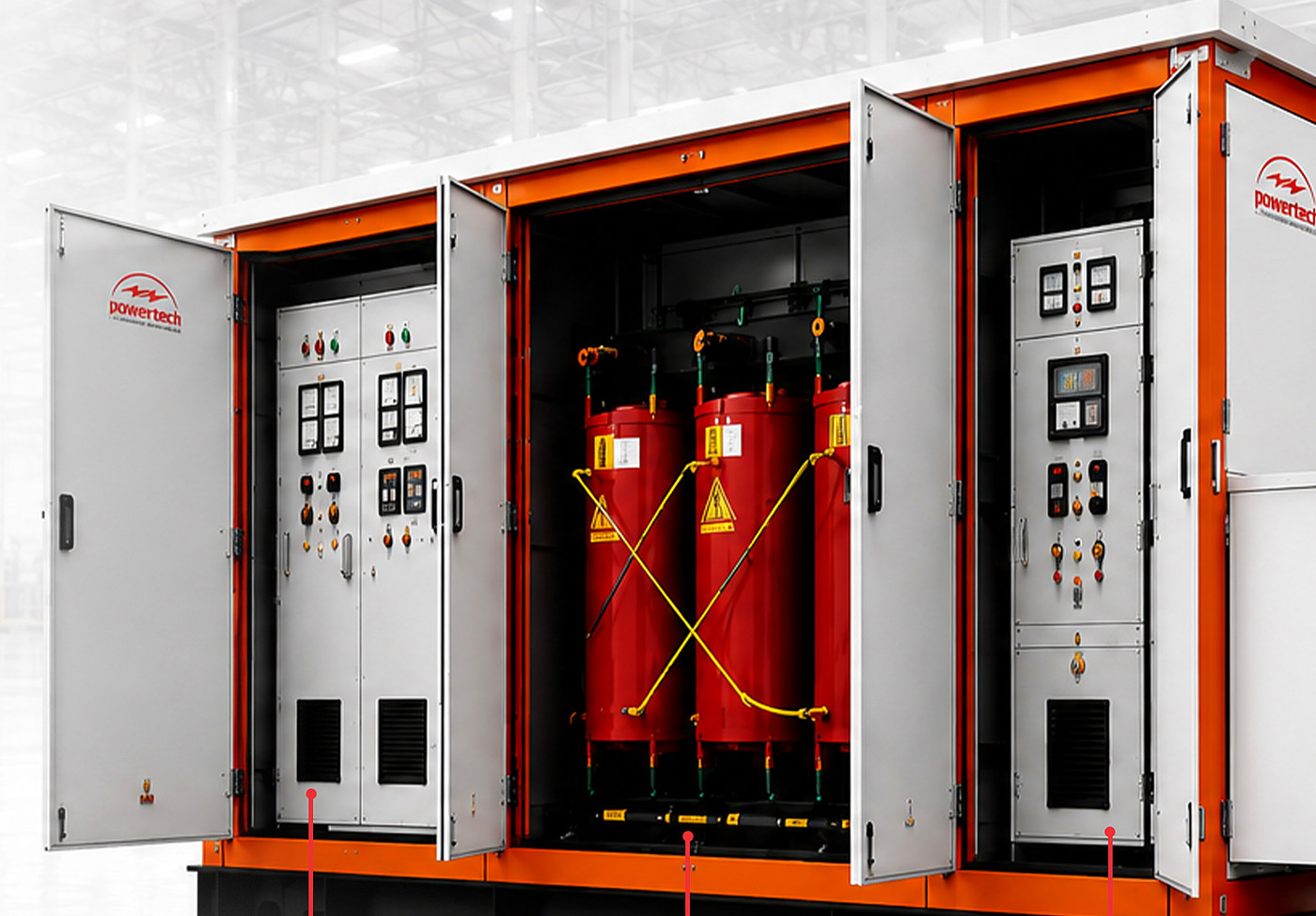
A compact secondary substation — CSS, or packaged substation — is a single enclosure containing three compartments: HT switchgear, a transformer, and an LT distribution board. It arrives at site assembled and tested, and it needs a plinth and cable terminations rather than a building.
What you actually gain
- Footprint. A CSS occupies a fraction of the area of a conventional substation room, which matters enormously on a constrained urban site.
- Programme. No substation building means no civil works on the critical path. Plinth, place, terminate, energise.
- Factory testing. The whole assembly is tested as a system before it leaves the works, not commissioned piecemeal on site.
- Safety. Everything live is inside a locked, interlocked, IP-rated enclosure. There is no room for anyone to walk into.
Where a CSS is usually the right answer
Solar plants, where you need identical repeatable units across a large site. Residential townships and gated communities, where a substation building is ugly and land is expensive. Industrial plant extensions, where there is no room left indoors. Temporary or relocatable supplies, because the whole unit can be lifted and moved.
Where it is not
If you need more than about 2500 kVA in one unit, or a complex HT scheme with multiple incomers, bus sections and elaborate protection, a conventional substation gives you room to work and room to extend. A CSS is a fixed, optimised package — that is its strength and its limitation.
Choose a compact substation when the scheme is settled. Choose a conventional substation when it is going to change.
What to specify
| Parameter | Typical range |
|---|---|
| Transformer rating | Up to 2500 kVA |
| HT voltage | 11 kV or 33 kV |
| LT voltage | Up to 1.1 kV |
| HT switching | VCB, SF6 or load break switch / RMU |
| Transformer type | Cast resin dry type, or oil filled |
| Enclosure protection | IP23 / IP43 / IP54 |
| HT short circuit withstand | Up to 25 kA |
| LT short circuit withstand | Up to 50 kA |
| Ambient | -5 °C to +50 °C |
One practical warning
Ventilation is the thing most often got wrong. A transformer inside a metal box in an Indian summer needs designed airflow, not louvres added as an afterthought. Ask your manufacturer for the thermal calculation, and check the enclosure rating is achieved with the transformer at full load in your site ambient — not at 20 °C in a laboratory.