
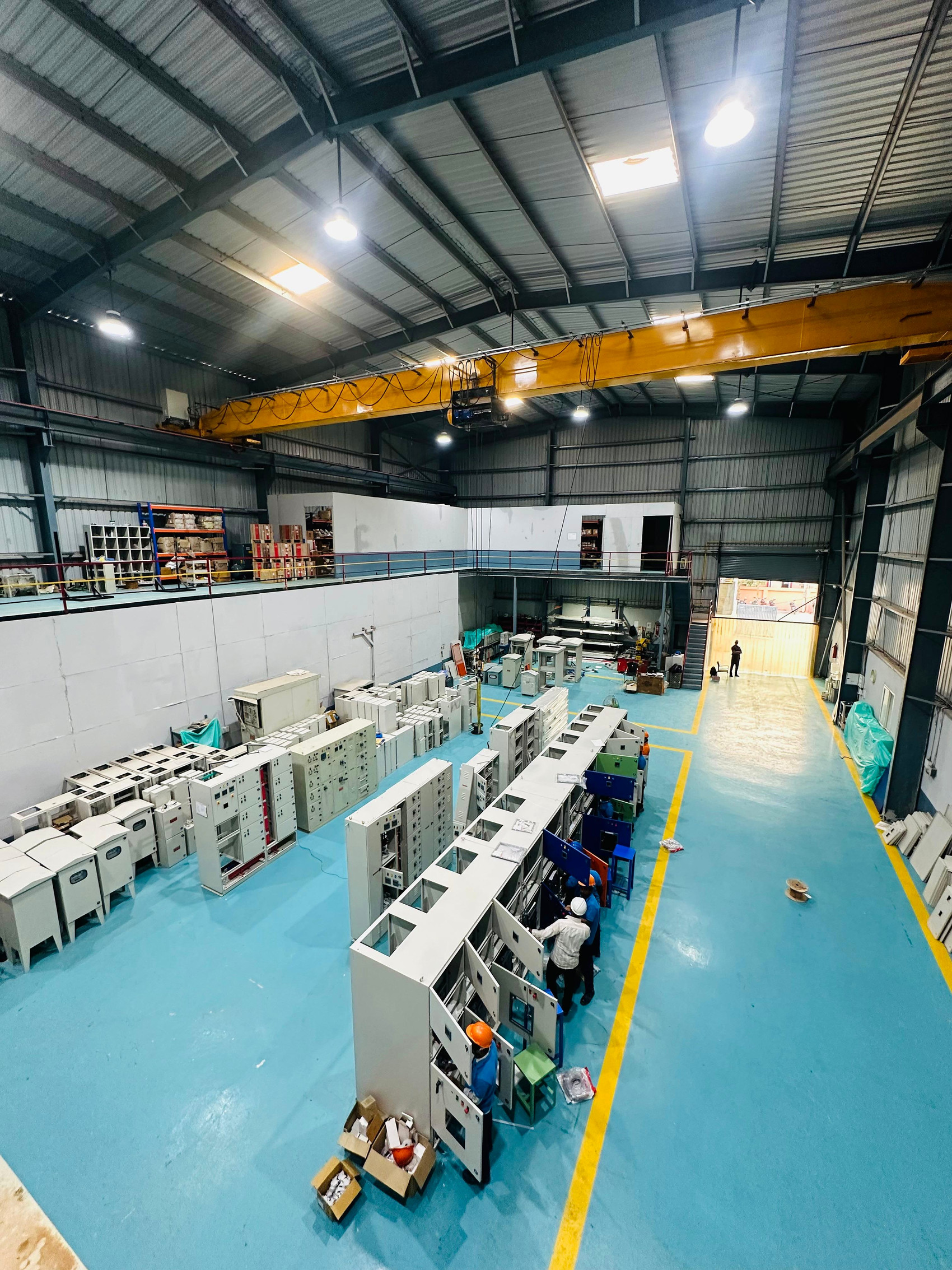
Most industrial consumers in Telangana and Andhra Pradesh are billed on a tariff that rewards a power factor above 0.95 and penalises anything below it. An APFC panel — automatic power factor correction — is usually the fastest-paying piece of electrical equipment on a site. It is also one of the most commonly mis-specified.
Where the saving comes from
- Penalty avoided, and often an incentive earned, on the monthly bill
- Lower current for the same real power, so cables and switchgear run cooler
- Released transformer capacity — correcting from 0.80 to 0.95 frees roughly 15% of your existing transformer for real load
- Less voltage drop at the far end of long distribution runs
The third point is the one people miss. If you are considering a larger transformer because you are near capacity, correct the power factor first and measure again. It is frequently cheaper than the transformer.
Sizing the bank
The kVAr required is your real power in kW multiplied by the difference between the tangent of the present angle and the tangent of the target angle. In practice: a 500 kW load at 0.80 corrected to 0.95 needs about 500 × (0.75 − 0.33) ≈ 210 kVAr.
Split that into steps. A single 210 kVAr contactor would hunt badly at low load. Six steps of 35 kVAr, or a mixed 2-2-4-4 arrangement, gives smooth correction across the day.
Where automatic correction goes wrong
Harmonics
Capacitors present a low impedance to high frequencies. On a site with significant drive or UPS load, a plain capacitor bank can resonate with the supply and draw far more harmonic current than you expect — a failure that shows up as blown capacitor fuses within months.
The answer is detuned reactors in series with each step, usually at 7% or 14%. If your site has drives, specify a detuned panel and do not accept a plain one because it is cheaper.
Switching transients
Energising a capacitor step draws a very high inrush. Contactors intended for capacitor duty, with damping resistors, are essential; a general purpose contactor will weld its contacts.
Over-correction
Leading power factor is penalised on many tariffs just as lagging is. A controller left on a fixed setting overnight, when the plant is off and only the lighting is running, will over-correct. Set the controller to a target rather than a fixed step count.
What a well-built APFC panel contains
| Component | Why it matters |
|---|---|
| Microprocessor PF controller | Targets a power factor rather than switching blindly |
| Capacitor duty contactors | Rated for the inrush, with damping resistors |
| Detuned reactors | Prevents resonance where harmonics are present |
| HRC fuses per step | A failed capacitor takes out its own step, not the panel |
| Forced ventilation | Capacitors lose life quickly above their rated temperature |
| Individually replaceable steps | Maintenance without shutting down correction entirely |
Send us a month of half-hourly demand data and the harmonic profile if you have it. Sizing from an actual load curve beats sizing from a nameplate every time.
A reasonable expectation
On a site with a genuine penalty, an APFC panel typically pays for itself within twelve to eighteen months, and then keeps paying. What it will not do is fix a power factor problem caused by an oversized, lightly loaded motor — that is a mechanical problem wearing an electrical disguise.